
New GC-DWC Book Chronicles 18 Years of Notre Dame’s Impact in Haiti, Offering a Data-Driven Roadmap for Global Education
The University of Notre Dame’s Global Center for the Development of the Whole Child (GC-DWC) announces the publication of Promoting a Child Development and Learning System in Haiti Amidst Conflict and Crises. Published by Springer Nature, this comprehensive volume chronicles the University’s eighteen-year commitment to strengthening education and child development systems in Haiti.
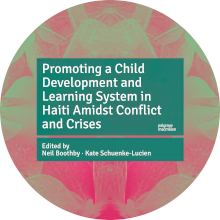
Edited by Neil Boothby, Professor and Director of the GC-DWC, and Kate Schuenke-Lucien, GC-DWC Director for Haiti and Senior Associate Director for Strategic Planning, the book offers a rigorous look at how the University has partnered with local institutions to navigate one of the world’s most complex humanitarian landscapes.
The volume is organized chronologically, tracing Notre Dame’s journey from its earliest engagement with the Catholic Church in Haiti to its most recent innovations. By weaving together historical perspective with cutting-edge research, including improvement science and randomized controlled trials, the book demonstrates how the University translates its mission into data-driven, scalable impact.
Centering Haitian Leadership and Voice
A cornerstone of the publication is its commitment to centering Haitian expertise. The chapters feature a collaborative effort between GC-DWC team members and distinguished Haitian scholars.
“This book is more than a chronicle of our work; it is a testament to the power of konbit… collective action,” says Tamara Doucet-Larozar, GC-DWC Associate Director of Language and Literacy and co-author of the book. “For too long, language has been a tool of exclusion in Haiti. By prioritizing mother-tongue literacy and tapping into local systems like the parish, we are moving beyond traditional aid models to build a future rooted in Haitian dignity and equitable access to education.”
The concluding chapter is authored by Jacky Lumarque, President of the Université Quisqueya, who reflects on the way forward:
“The Haitian proverb Men anpil, chay pa lou [Many hands lighten the load] captures the way forward… While rooted in the Haitian context, strategies centered on dignity, local agency, and community ecosystems demonstrate the resilience, creativity, and potential of communities to transform education.”
A Vision for the University’s Global Mission
For University leadership and the broader academic community, this volume stands as a model for how the University of Notre Dame accompanies global partners through long-term crises, embodying the University’s mission to be a 'force for good' in the world. By focusing on the preferential option for the poor and the inherent dignity of every child, the book demonstrates how rigorous scholarly research and Catholic Social Teaching converge to address systemic injustice and create lasting paths out of adversity.
“Boothby and Schuenke-Lucien’s book makes a rare and vital contribution,” shared Brian Hayes, Regional Director of Porticus North America. “While many have extensively studied fragile states through the lenses of conflict and governance, very few works trace the long arc of educational innovation under such conditions. This book uniquely chronicles nearly two decades of Notre Dame’s work in Haiti... Readers will find much to be hopeful for when systems and institutions put the needs of the children they serve at the center.”
“The work in Haiti bridges the central mission of Notre Dame, connecting research, practice, and formation in the service of others,” shared Matthew Kloser, Hackett Family Director at the Institute for Educational Initiatives. “It has been a seedbed for child development in one of the most unstable countries in the Western Hemisphere. This volume not only showcases the work that has been done over time but also demonstrates the continued impact of our research both locally and globally.”
Key Contributions
The book includes chapters authored by GC-DWC team members who lead the Center’s work in Social and Emotional Learning (SEL), social enterprise, and Early Childhood Development (ECD). Their research highlights the L3 Systems Activation Model—Lakay, Lekòl, Legliz (Home, School, Church)—as a framework for sustainable development. Unlike traditional aid models that often attempt to build new structures from scratch in a "predatory state," the L3 model achieves sustainability by activating existing, deeply-rooted parish infrastructures that are already integrated into the fabric of Haitian life.
A Blueprint for Global Change
While focused on Haiti, the volume provides a vital blueprint for global policymakers and practitioners working in other fragile or conflict-affected states. It offers evidence-based insights into how long-term, partnership-based commitment can create resilient child development systems even in the most challenging contexts.
Promoting a Child Development and Learning System in Haiti Amidst Conflict and Crises is available for purchase now at https://link.springer.com/book/10.1007/978-3-032-14361-7
To learn more about the University’s ongoing impact in Haiti, visit https://iei.nd.edu/gc-dwc-haiti
About the Global Center for the Development of the Whole Child (GC-DWC)
The Global Center for the Development of the Whole Child (GC-DWC) at the Institute for Educational Initiatives at the University of Notre Dame collaborates with researchers and practitioners to ensure the well-being—physical, emotional, social, and cognitive—of children and adolescents in low-resource and conflict-affected settings. Established to serve as a coherent platform for the Institute for Educational Initiative’s growing portfolio of global child development and learning programs, the GC-DWC creates environments that foster resilience and encourage children and adolescents to thrive. Using an innovative Whole Child Development (WCD) approach tailored to context-specific needs, the GC-DWC translates research into timely and thoughtful action, adapts research tools to improve the development of learning programs and policies, and activates systems (families, schools, communities) to lift children and adolescents out of adversity.
Learn more about the GC-DWC’s work to transform child development globally: iei.nd.edu/gc-dwc
